Tuesday, November 25, 2008
Pynchon Watch Y2K9: Here we go again
There's new details about Inherent Vice. Like, you know, the fact that Inherent Vice is the new Thomas Pynchon book I started anticipating two months ago and will not stop anticipating until August 2009, when I am able to buy it, and wrap my grubby little paws around all 400+ pages of it. Just enough time to re-read The Crying of Lot 49. And maybe V. Okay, maybe both.

"Joe the Plumber Signs Publishing Deal"--proving that, even after the recent breath-of-fresh-air election results, the world's still fundamentally bat-shit bozo.
Friday, November 21, 2008
Oh, and I knew I was reminded of something by the thought of Kafka in translation: Maud Newton pointed out a while back a bit by translator Breon Mitchell about translating the opening line of The Trial, which, for me, pretty much casts the entire affair of translation in a sharp light. Neither a good one nor a bad one.
(I've been meaning, and forgetting, to pick up that translation ever since reading that quote. Perhaps, now, soon.)
(I've been meaning, and forgetting, to pick up that translation ever since reading that quote. Perhaps, now, soon.)
The folks at Schocken Books were kind enough to send me a copy of Mark Harman's new translation of Franz Kafka's Amerika: The Missing Person. Which I'm reading a bit of now. And enjoying. It's part of the Kafka I've never read before, so I can't comment on the quality of the translation or the difference between this translation and those that preceded it. But I can comment on the fact that it's interesting, trying to read Kafka, and trying to react to Kafka, without resorting to the reaction of, "Hey, that's Kafka." Interesting in that, I may have only now come to believe, I've got no real idea what Kafka's up to. Ever. It's too easy to accept the weirdness of him without questioning it--if it really is that weird, or "dreamlike," as one blurb states, or why it's that way, whatever way it actually is. Heaven knows, that strangeness, that sought-after Kafkaesqueness, that's how I came around to The Trial my first couple times through it. You know, you read Kafka because, he's Kafka. What else do you need, you know? Well, now I don't know, and I'm curious about it.
Long way of saying I'm trying to be a bit critical, a bit analytical. At least of my own reaction to the text, if not as much to the text itself as one or some might like. But. So. Maybe more so than usual, we'll see.
Long way of saying I'm trying to be a bit critical, a bit analytical. At least of my own reaction to the text, if not as much to the text itself as one or some might like. But. So. Maybe more so than usual, we'll see.
Friday, November 14, 2008
Thursday, November 13, 2008
I'd like you to know I've read none of 2666. Sue me.
However, as part of a growing interested in kicking around at least a little more translated literature than is typical for me (or, some might say, for America), I have just finished Bragi Ólafsson's The Pets, which I agree with the Complete Review was an "enjoyable entertainment," though certainly not an unflawed one. Spoiler alert!: there's a difference between stopping a story and finishing a story, an art to the endless ending, a fine line between intriguing and annoying. Still: a good read, more than a palate cleanser, not quite a complete course. Were more of his books to appear in English, I'd likely pick them up.
Plus: one of the best covers of the year.
However, as part of a growing interested in kicking around at least a little more translated literature than is typical for me (or, some might say, for America), I have just finished Bragi Ólafsson's The Pets, which I agree with the Complete Review was an "enjoyable entertainment," though certainly not an unflawed one. Spoiler alert!: there's a difference between stopping a story and finishing a story, an art to the endless ending, a fine line between intriguing and annoying. Still: a good read, more than a palate cleanser, not quite a complete course. Were more of his books to appear in English, I'd likely pick them up.
Plus: one of the best covers of the year.
Tuesday, November 11, 2008
Unintentionally hilarious headline of the week
"Only Two Percent of Bloggers Can Make a Living"
(And the other ninety-eight percent are too young to get their work permits?)
(Here.)
(And the other ninety-eight percent are too young to get their work permits?)
(Here.)
Monday, November 10, 2008
"We don’t yet understand how to model a complex conversation in the web’s two-dimensional environment and we’re hoping this experiment will help us learn some of what we need to do to make this sort of collaboration as successful as possible."
Nice! (Via.)
Nice! (Via.)
Thursday, November 06, 2008
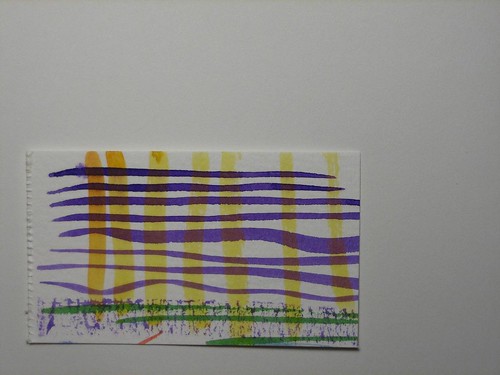
It's not that pictures have equivalent values in words. It's that they're unique currencies, nonexchangeable. Compare the word "red" with the sight of red. One red or another. Any red. Context.
Yet it's hard to read The Horse's Mouth without wanting to make imagery. The words are terrific, evocative. And me, I paint, a little. Nowadays. Play with paint, at least. Push it into lines and shapes, complex or simple. I suppose I'm glad aspects of my life are colluding this way, distracting from some things in pursuit of others.
And have I mentioned, how the humor in the book is spot-on; Cary's got genius-level comedic delivery. Light of heart, light of touch. And...well, it's a stretch, but in an effort to sell five copies of this book, I'll toss this off-hand comment out there: it occasionally reminds me of The Unconsoled by Kazuo Ishihuro. The witless artist, caught on the way to the masterpiece than never quite masters, seems stuck in pieces. Well.
(More watercolor fragments flickrwards.)
Tuesday, November 04, 2008
A merry band of bloggers are considering taking on The Recognitions by William Gaddis in the coming months. Though there may or may not be alcohol involved this time through, I am curious to see (and, perhaps, partake in) what comes of it, and of the potential for old conversations to be revisited by new conversationalists.
Sunday, November 02, 2008
"The fact is, I was sick of that god-damned picture."
"It was the finest picture I ever saw," said Nosy, getting angry with me. "You m-mustn't s-say such things."
"I never knew how I hated it," I said, "till now. I've disliked all my pictures, but I never hated one so much as the Fall."
"Mr. J-Jimson," said Nosy. "No p-please--it's not a joke." The poor boy was in agony. I was blaspheming against his faith.
"But what I do like," I said, "is starting new ones." And the very notion made me feel full of smiles. The vision of the nice smooth canvas in front of me, say the Ruffiano, newly primed in white, and then the first strokes of the brush. How lovely the stuff is when you've just put it down. While it's still all alive and before it dies and sinks and fades. Paint. Lovely paint. Why, I could rub my nose in it or lick it up for breakfast. I mean, of course, paint that doesn't mean anything except itself. The spiritual substance. The pure innocent song of some damn fool angel that doesn't know even the name of God.
- from The Horse's Mouth by Joyce Cary
Blah blah blah, I really like this book, etc etc etc, I think you might like it as well, so on and so forth, it's really keen stuff.
("The spiritual substance. The pure innocent song of some damn fool angel that doesn't know even the name of God," in-deed. Language. Lovely language.)
Wednesday, October 29, 2008
I think the most important thing I took away from this was that oh sweet Jesus The Stand is thirty years old how old am i oh what the shit.
It's a little thing, but...
...the swift deployment of such a field of simile does suggest a deeper involvement with and interest in the formal qualities of language and literature than might be otherwise immediately apparent in this book. To me, at least. Keep on the lookout.
To extend via comparison: while it's tired to harp on the current state of classroom-based education of writing, I'll still suggest it's hard to imagine a paragraph as sublime and illustrative as the preceding surviving a contemporary workshop critique session. Are there writers today who can use figurative, almost to the point of bordering on becoming (but not actually becoming) symbolic, language in such a way and get away with it?
"It is very awkward," Mr. Alabaster said, and then suddenly I knew his look. It was the look of a man who can't pay for a drink. "By God," I thought, "I believe the Professor is broke."
So I took an inventory of the smart young gentleman and there was a piece of his shirt sticking out of his trousers, a little piece no bigger than a sixpence but blue as the North star. Indication to mariners. And when I looked longer I saw that his shiny brown boots were down on one side like torpedoed ships. There was a fringe on the back of his trousers like old flags after the battle and the breeze, and his collar had an edge like a splintered mast.
- from The Horse's Mouth by Joyce Cary
...the swift deployment of such a field of simile does suggest a deeper involvement with and interest in the formal qualities of language and literature than might be otherwise immediately apparent in this book. To me, at least. Keep on the lookout.
To extend via comparison: while it's tired to harp on the current state of classroom-based education of writing, I'll still suggest it's hard to imagine a paragraph as sublime and illustrative as the preceding surviving a contemporary workshop critique session. Are there writers today who can use figurative, almost to the point of bordering on becoming (but not actually becoming) symbolic, language in such a way and get away with it?
Monday, October 27, 2008
Matt, glad you asked; Joyce Cary is an Irish-born, first-half-of-the-20th-century writer who, despite having appeared on the cover of Time and being the subject of a Paris Review interview ("I’m no life-force man. Critics write about my vitality. What is vitality? As a principle it is a lot of balls. The life force is rubbish, an abstraction, an idea without character."), appears to receive little love today, at least based on the totally informal survey done by plugging his name into my Google Reader feed list and noting the couple resulting relevant posts. Still, the existence of a fairly detailed Wikipedia entry must be worth something, correct? Or something. At least it's one more link for me to come back to when I'm done reading this book.
This book, The Horse's Mouth, which I discovered quite by accident one Friday night out with my girlfriend at a local bookshop; being the sort of fellow for whom the New York Review Books seal and binding has come to represent a certain something that I want out of literature, I was bound to pick it up. Being the sort of fellow for whom paint has recently become a medium and substance of no small personal and expressive interest, a NYRB-sealed book about a painter was one I was bound to purchase. Even if only with vague intents to read it. Some day. Some day like the day (yesterday) I got halfway through Sabbath's Theater and realized that, at least for the time being, I was quite over-Rothed. I'm over-Most things these days, seems like, seeming as it is I've put down half-read more books than I've picked up to begin with, and what have you. All to say that to feel not just engaged after fifty pages but more engaged than I was at the start of the book is to feel not just correct but net-gained, right about now.
Language like this doesn't hurt matters much:
...Which is really much less dense, much lighter than it feels, as prose goes. Not quite light as air, but certainly light as, oh, say, the light that bounces through watercolor pigments, off the page, and back to your eyes. Works of passion and imagination, indeed: to see the world like a painter. (Cary, from the back-of-the-book bio, was originally trained as a painter.)
This book is the final book of a trilogy, which the back of the book swore could be read independently of the first two, though I'm thinking I'm going to wander back around to the first two in the series soon after I polish off this guy, if it goes as well throughout as it has so far. I can certainly see Cary showing me some path away from the post-Pynchon flubber-bloody hung-over funk that's landed on my skull after finishing Against the Day. As the man of the hour says:
This book, The Horse's Mouth, which I discovered quite by accident one Friday night out with my girlfriend at a local bookshop; being the sort of fellow for whom the New York Review Books seal and binding has come to represent a certain something that I want out of literature, I was bound to pick it up. Being the sort of fellow for whom paint has recently become a medium and substance of no small personal and expressive interest, a NYRB-sealed book about a painter was one I was bound to purchase. Even if only with vague intents to read it. Some day. Some day like the day (yesterday) I got halfway through Sabbath's Theater and realized that, at least for the time being, I was quite over-Rothed. I'm over-Most things these days, seems like, seeming as it is I've put down half-read more books than I've picked up to begin with, and what have you. All to say that to feel not just engaged after fifty pages but more engaged than I was at the start of the book is to feel not just correct but net-gained, right about now.
Language like this doesn't hurt matters much:
There was a street market on the curb. Swarms of old women in black cloaks jostling along like bugs in a crack. Stalls covered with blue-silver shining pots, ice-white jugs, heaps of fish, white-silver, white-green, and kipper gold; forests of cabbage; green as the Atlantic, and rucked all over in permanent waves. Works of passion and imagination. Somebody's dream girls. Somebody's dream pots, jugs, fish. Somebody's love supper. Somebody's old girl chasing up a tidbit for the old china. The world of imagination is the world of eternity. Old Sara looking at a door knob. Looking at my old ruins. The spiritual life.
- from The Horse's Mouth by Joyce Cary
...Which is really much less dense, much lighter than it feels, as prose goes. Not quite light as air, but certainly light as, oh, say, the light that bounces through watercolor pigments, off the page, and back to your eyes. Works of passion and imagination, indeed: to see the world like a painter. (Cary, from the back-of-the-book bio, was originally trained as a painter.)
This book is the final book of a trilogy, which the back of the book swore could be read independently of the first two, though I'm thinking I'm going to wander back around to the first two in the series soon after I polish off this guy, if it goes as well throughout as it has so far. I can certainly see Cary showing me some path away from the post-Pynchon flubber-bloody hung-over funk that's landed on my skull after finishing Against the Day. As the man of the hour says:
I got some real colors and a couple of brushes at last, and made for the studio. I felt I could paint. As always after a party. Life delights in life.
- from The Horse's Mouth by Joyce Cary
Sunday, October 26, 2008
"Your c-coffee, Mr. Jimson."
"Mr. jimson has just gone out. He must have seen you coming."
But the boy switched on his bicycle lamp; and came right in and put the coffee in my hand.
"Mr. Jimson won't be back for some time," I said. "But he asked me to tell you that you haven't got a chance. He isn't going to talk to you about art. He's committed arson, adultery, murder, libel, malfeasance of club monies, and assault with battery, but he doesn't want to have any serious crime on his conscience."
"B-but, Mr. Jimson, I w-want to be an artist."
"Of course you do," I said, "everybody does once. But they get over it, thank God, like the measles and the chickenpox. Go home and go to bed and take some hot lemonade and put on three blankets and sweat it out."
"But Mr. J-Jimson, there must be artists."
"Yes, and lunatics and lepers, but why go and live in an asylum before you're sent for? If you find life a bit dull at home," I said, "and want to amuse yourself, put a stick of dynamite in the kitchen fire, or shoot a policeman. Volunteer for a test pilot, or dive off Tower Bridge with five bob's worth of roman candles in each pocket. You'd get twice the fun at about one-tenth of the risk."
I could see the boy's eyes bulging in the reflected light off the boards, the color of dirty water. And I thought, I've made an effect. "Now go away," I said. "It's bedtime. Shoo."
- from The Horse's Mouth by Joyce Cary
Sunday, October 19, 2008
Saturday, October 18, 2008
Notes from Jonathan Lethem's appearance at CIA
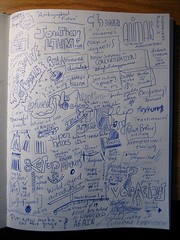
Notes from Jonathan Lethem's appearance at the Cleveland Institute of Art, 10/2/2008
Originally uploaded by thegrue76
(There's a larger version over on the Flickr page under "All Sizes".)
Friday, October 17, 2008
A writer with a bountiful financial cushion recently complained to me that he had to spend a whole week coming up with an idea. I wonder if he truly loves his art. I certainly do, and have more ideas than time available.
- Ed
You can love something but still be a total douchetard about it. I mean, if that wasn't possible, we wouldn't have romantic comedies, or the current state of politics in America. Okay, bad examples.
Thursday, October 16, 2008
Subscribe to:
Posts (Atom)